
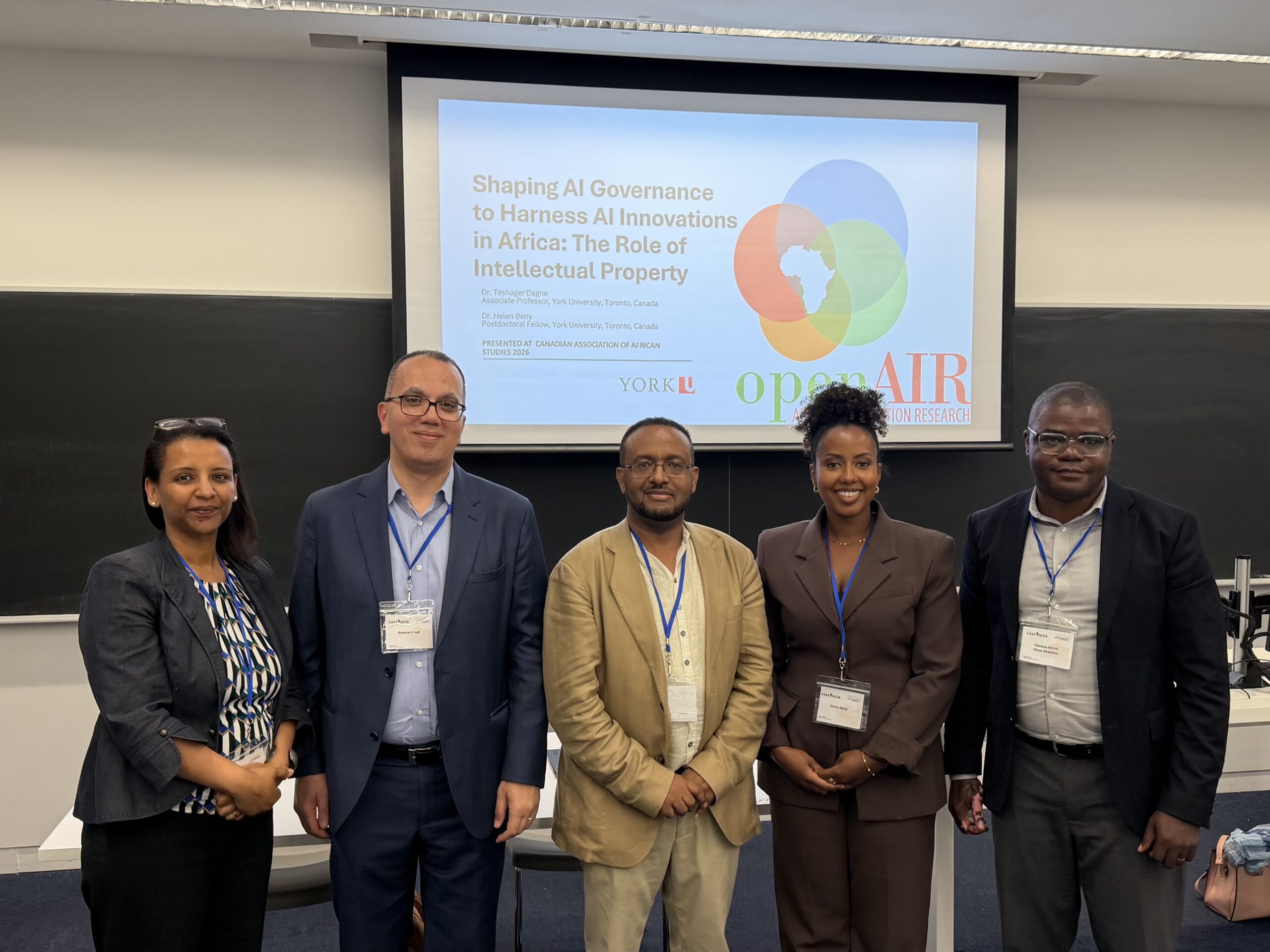
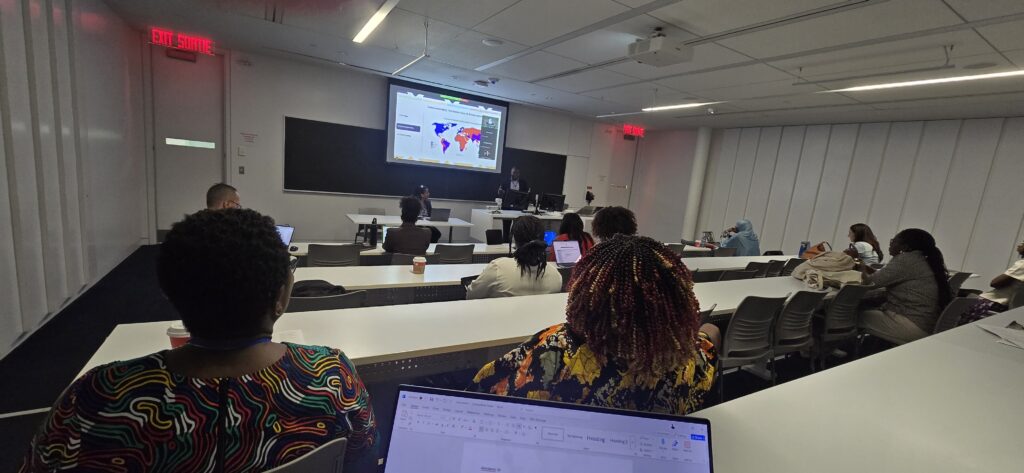
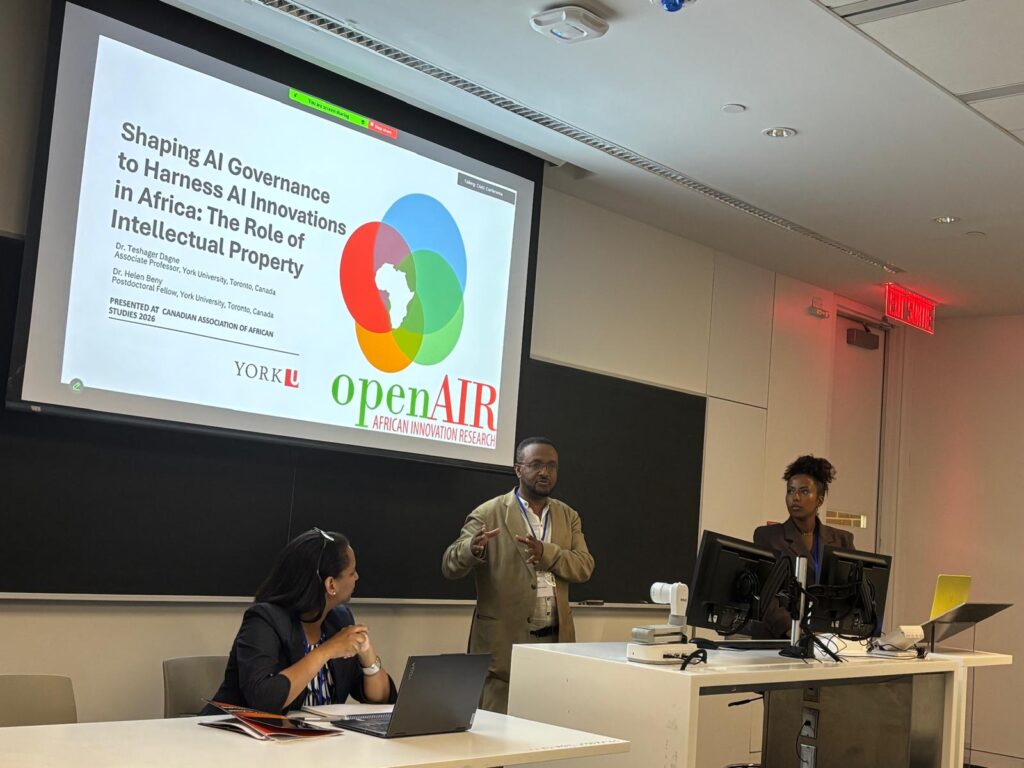
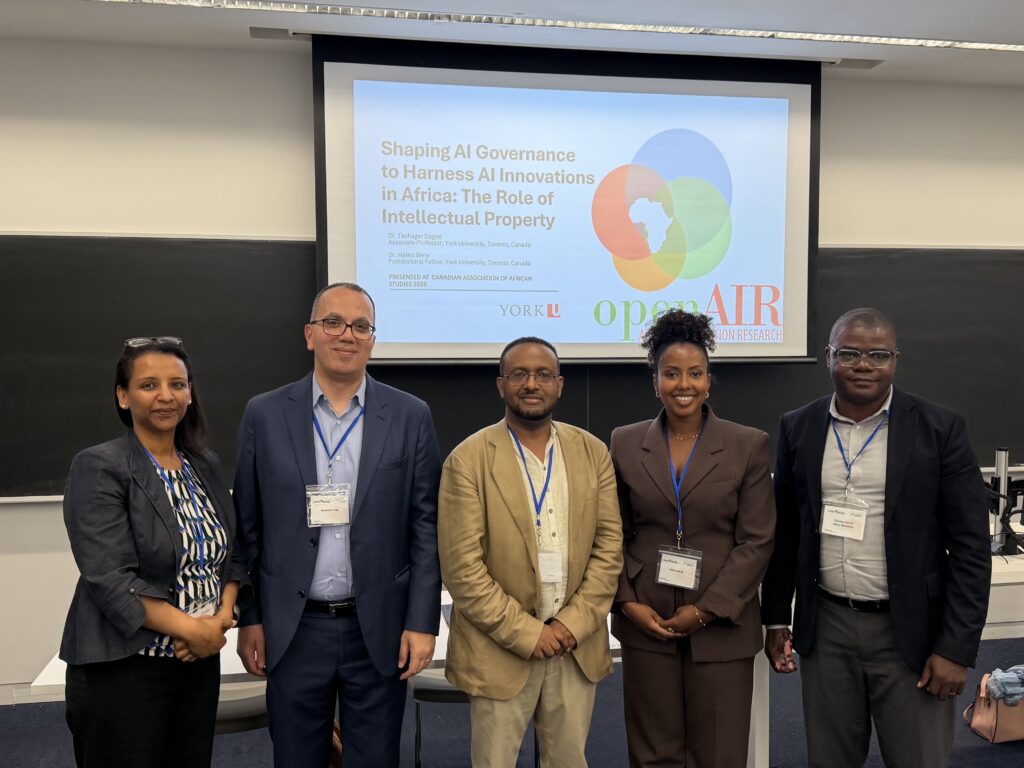
On June 10th, at York University’s Glendon Campus, the Canadian Association of African Studies hosted their annual conference. Dr. Tesh W Dagne and Dr. Helen Beny co-organized a panel titled Artificial Intelligence and Innovation in Africa: Rules, Norms and Challenges for Context-responsive AI Ecosystem, with co-panellists Dr. Thomas Hervé Mboa Nkoudou and Dr. Bassem Awad, and conversation facilitated by Doctoral candidate Aida Abraha.
The panel explored decolonizing AI governance and innovation, Africa’s position within the global AI value chain, and intellectual property in community-oriented AI contexts.
The panel opened with Dr. Thomas Hervé Mboa Nkoudou, who shared his research on decolonizing AI, navigating AI hype and how these dynamics can marginalize local knowledge systems and constrain local innovation. He identified these constraints as rooted in structural local barriers, the geopolitical dynamics of colonialism, a scarcity of local talent, and the perception of regulation as a barrier to innovation. Dr. Bassem Awad then examined the inconsistent legal frameworks and limited institutional capacity within national and regional IP frameworks, before articulating policy objectives that underscore the need for African governments to assert sovereign control over their data. Lastly, Dr. Dagne and Dr. Beny presented on how IP rules and practices shape community-oriented AI innovation. The two shared their taxonomy of AI innovation and findings from classifying it across Ethiopia, Egypt, South Africa, Nigeria, and Kenya, spanning health, education, agriculture, and low-resource language models. They also highlighted key cases of indigenous AI innovation in Africa and the IP challenges technologists face in deployment and use.
The discussion generated questions across two themes. The first centred on governance and geopolitics: what decolonized or Afrocentric AI looks like in practice beyond local deployment, what it would mean for Africa to become a genuine normative actor in global AI governance over the next decade, and how African countries can pursue AI-driven development and investment while maintaining sovereignty over their data and knowledge resources. The second cluster focused on our taxonomy research: what patterns emerge across the health, agriculture, education, and low-resource language sectors in how AI is adopted and designed locally, and what those patterns reveal about the adequacy of existing IP frameworks for governing community-oriented AI innovation.
The organizers thank the audience for their thoughtful engagement and the rich conversation that followed. The questions pushed presenters to think more precisely about the practical implications of their research frameworks and reinforced the value of presenting work in progress to a critical, interdisciplinary, and knowledgeable community. Organizers are also grateful to the Canadian Association of African Studies for the opportunity and look forward to continued dialogue as Open AIR’s work on AI governance and innovation in Africa evolves.