
Open AIR East Africa Distinguished Speaker Series: Dr. Henry Mutai on...
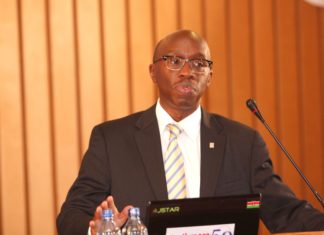
On 10 June 2015, the Agreement establishing a Tripartite Free Trade Area (TFTA) was signed in Egypt bringing together 26 African countries from three major regional blocs: the Common Market for Eastern and Southern Africa (COMESA), the East African Community (EAC), and the Southern African Development Community (SADC). Following the signing, the current phase of the TFTA negotiations are meant to cover five agenda items: trade in services, cooperation in trade and development, competition policy, intellectual property (IP) rights, and cross-border investment. The fourth of those five issues was the subject of the second Open AIR East Africa Distinguished Speaker Series presentation by Dr. Henry Kibet Mutai.
WIPO 33rd IGC Session Puts Traditional Cultural Expressions (TCEs) on the...
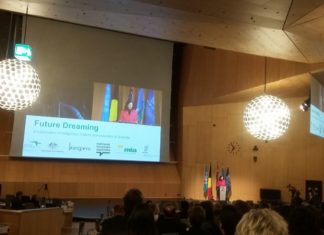
The WIPO-IGC recently commenced the next installment of its deliberations for a text-based instrument that focuses on the protection of traditional cultural expressions (TCEs), pursuant to its mandate. There are two scheduled forums on TCEs beginning Feb 27-March 3 and to be completed in June 2017, which will round off the Committee’s work for the 2016-17 biennium.
Recognizing Informal Sector Innovation: Implications for Traditional Knowledge Development in Africa
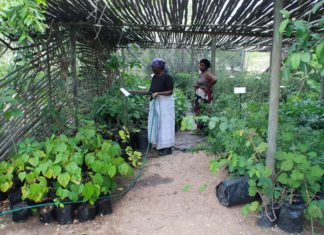
In 2012, a civil society group called the Alliance for Food Sovereignty in Africa (AFSA), raised concerns about a draft Africa Regional Intellectual Property Organization (ARIPO) plant variety protection protocol. AFSA was concerned,
Makerspaces and Creativity

Looking back at Open AIR’s ‘Making’ Innovation Happen roundtable
By Sean Boots
In mid August, Open AIR hosted a roundtable discussion on makerspaces and innovation hubs in...
Dr. Kakooza “Dealing with Trans-Border Quasi-Intellectual Property”

In October 2010, Yoweri Museveni, the President of Uganda, recorded a rap song titled: "Do You Want Another Rap?" as part of his re-election campaign to capture the imagination of young voters. The song was a huge success and may have played a part in his reelection. When Museveni applied for a copyright registration of the song, however, members of the Ankole community filed an objection stating that the song was derived from Ankole folklore. While the Registrar of Copyrights in Uganda eventually allowed Museveni's copyright application for registration, this case triggered Dr. Anthony Conrad K. Kakooza's interest in the area of traditional cultural expressions (TCEs) and whether TCEs should be recognized within the domain of intellectual property (IP) law.
Drawn Out Battle Over Genetic Resources Dampens Africa’s Hopes

The global South is full of significant, diverse biological and genetic resources. It’s also home to most of the world’s indigenous communities. This is why developing countries are sensitive about protecting their genetic resources and traditional knowledge.
Prof. Osei-Tutu speaks at the University of Ottawa

Too often, scholarly work and debates relating to Intellectual Property (IP) have focused on the protection and profits of the IP holder, as opposed to promoting open-access and the broader interests of the community. In her talk at the University of Ottawa on February 9th, Professor Janewa Osei-Tutu suggested we readjust the lens through which IP innovation is examined, using human development as the standard.
Open Call for Case Studies

Open AIR is calling for African case studies that shed light on the following two overarching research questions:
How can open collaborative innovation help businesses scale up and seize the new opportunities of a global knowledge economy?
Which knowledge governance systems will best ensure that the social and economic benefits of innovation are shared inclusively across society as a whole?
Place-Based Branding for Locally Specific Products
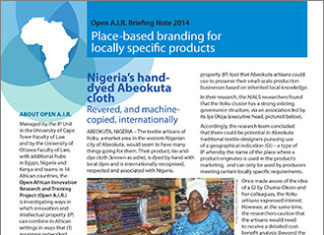
Published by Open AIRPublication Date: 2014 Download: Briefing Note: Place-Based Branding for Locally Specific Products (392KB)
This 2014 Briefing Note outlines findings from Open AIR...
Managing Benefits from Traditional Knowledge (TK)
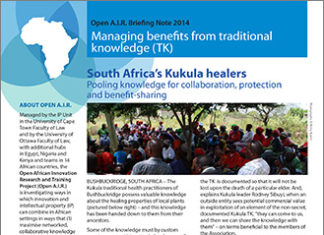
Published by Open AIRPublication Date: 2014Download: Briefing Note: Managing Benefits from Traditional Knowledge (TK) (403kb)
This 2014 Briefing Note highlights the findings from Open AIR research...